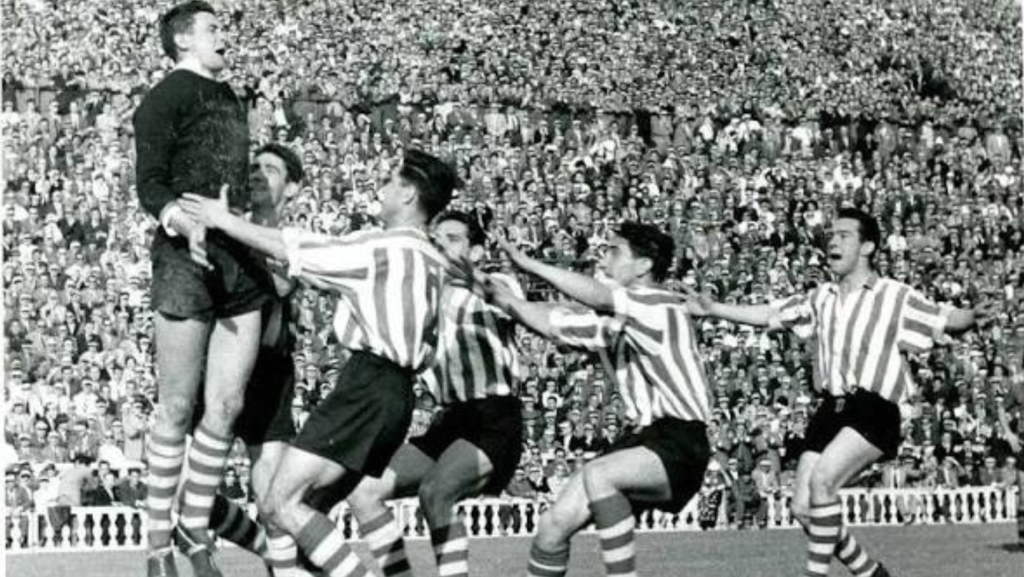
There are moments in football history that transcend the boundaries of the pitch and become permanently etched in the collective memory of an entire people. One of the most powerful and enduring took place on 5 December 1976 at the old Atocha Stadium, when the captains of Athletic Club and Real Sociedad led their teams onto the field carrying together a flag that, at the time, was still illegal.
That 1976 Basque derby became deeply engraved in the Basque collective memory not because of the result, but because of the courage and unity shown by both teams. Nearly five decades later, the legendary ikurriña that defined that historic occasion has returned with full honours to the new San Mames Stadium, once again carried by the two legends who held it aloft on that winter afternoon: the eternal José Ángel Iribar and the Real Sociedad icon Inaxio Kortabarria.
The 1976 Derby: the origin of a historic gesture in Basque football
The hidden story of that December afternoon is marked by tension and secrecy. The original idea was born in the Real Sociedad dressing room, led by player Josean de la Hoz Uranga, whose sister secretly made the flag at her home in Getaria. On the day of the match, the player managed to evade a Civil Guard checkpoint on the road and, once at the Atocha stadium, smuggled the banned flag into the venue through a window that led directly to the dressing rooms.
The ikurriña was kept hidden inside the masseurs’ bag of sponges and water right up until the moment before stepping onto the pitch. As they emerged from the tunnel, both teams walked out together in a single line — an unprecedented act at the time — breaking with protocol and taking the authorities present by surprise.
Iribar and Kortabarria: two captains bound by a shared symbol
The weight of leading that political and social challenge fell on the shoulders of two men who embodied the brilliance and dignity of Basque football. The Athletic Club goalkeeper, José Ángel Iribar, and the Real Sociedad defender, Inaxio Kortabarria, took on that responsibility with remarkable composure. When De la Hoz Uranga stepped onto the pitch from the stands to hand them the tricolour flag, both captains unfolded it firmly and walked together, holding it at each end, all the way to the centre circle.
That image of unity between the Athletic goalkeeper and the San Sebastian defender seemed to freeze time at the home ground in Gipuzkoa, transforming their usual sporting rivalry into an unbreakable alliance that symbolised the aspirations for freedom of an entire society.
The ikurriña in football: from symbolic gesture to collective icon
What began as a bold, semi-clandestine act on a football pitch ended up accelerating broader political normalisation in the streets. The standing ovation and the tears of the thousands of fans who filled the stands at Atocha showed that football could act as a powerful social catalyst.
That pioneering gesture by the two most representative clubs of Bizkaia and Gipuzkoa transformed the flag into a collective icon of harmony, paving the way for the ikurriña to be finally legalised just a few months later, in January 1977. From that moment on, football grounds across the Basque Country became spaces of free expression and affirmation of local culture, demonstrating that identity is best defended through mutual respect.
Return to San Mames: memory, emotion and the present
Nearly fifty years after that historic feat, the original cloth returned to the pitch in a moment filled with mysticism and solemnity during the Mitoaroa III show by the band ZETAK. The project’s leader, Pello Reparaz, conceived the event as a profound musical and cultural statement, blending electronic sounds with the rich tradition of Basque folk music.
The climax of the night came when Iribar and Kortabarria once again crossed a cross-shaped walkway over the pitch, surrounded by the striking and ancestral visual presence of the momotxorroak from Altsasu, with their horned masks. The roar of the thousands filling the stadium captured a perfect generational relay, where grandchildren applauded the courage of those grandparents who, in 1976, risked their freedom to defend a shared feeling.
A historical journey of loyalty and memory that supporters can now commemorate by visiting the collections at AC Museum, where the great milestones of Athletic Club’s identity are preserved.